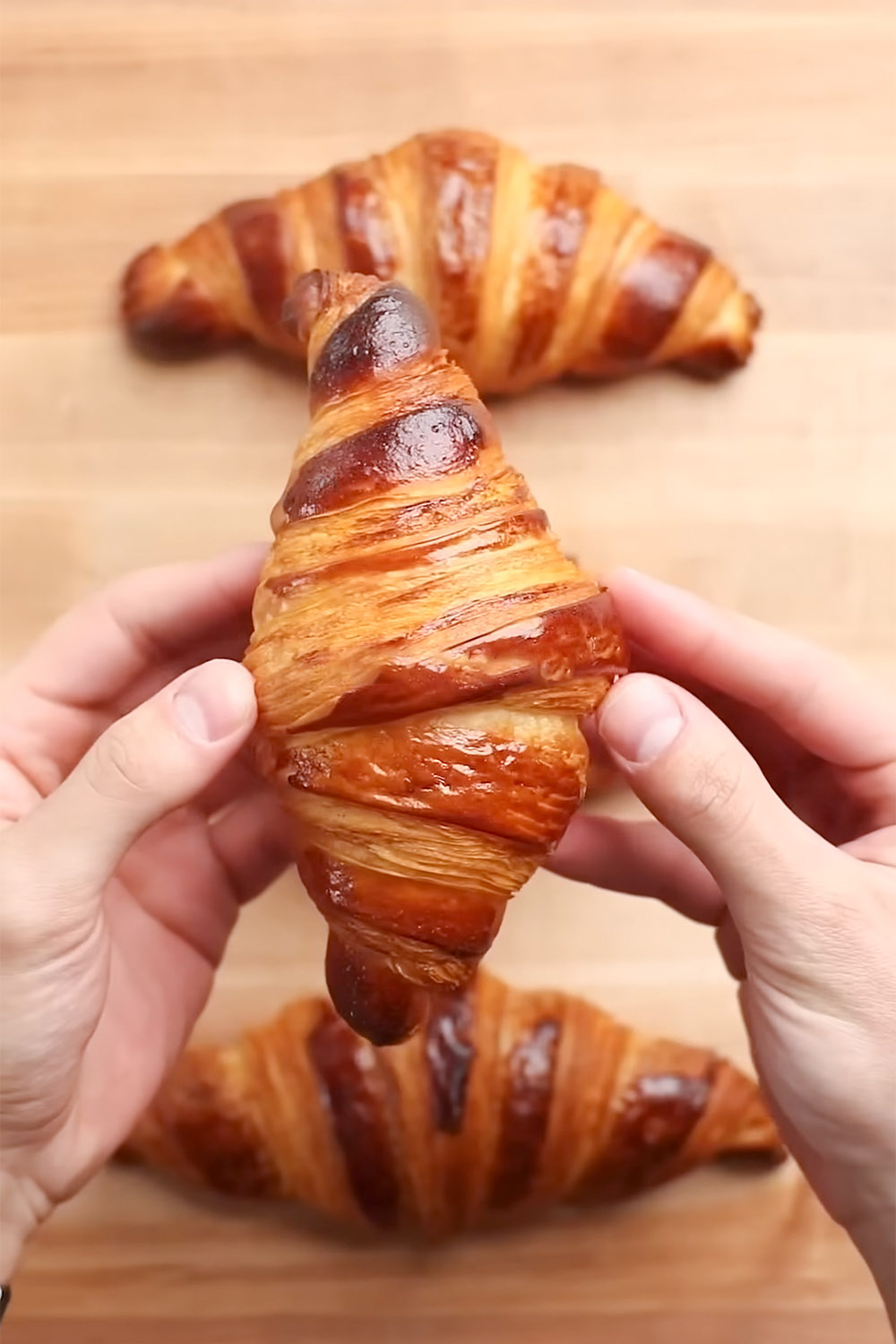
Homemade Croissants
The dough is layered with butter and then folded over and over again. This special technique (laminated dough) gives these croissants their signature flaky layers that we've been obsessing over for decades!
Print Recipe
Pin
Servings: 16
Calories: 196kcal
Ingredients
Croissant Dough
- ¼ cup softened, unsalted butter, room temperature
- 4 cups spooned and leveled all-purpose flour (+ excess flour for shaping and rolling)
- ¼ cup granulated sugar
- 2 tsp salt
- 1 tbsp yeast (instant yeast or active dry yeast)
- 1 ½ cups cold whole milk
Buttery Layer
- 1 ½ cups softened, unsalted butter, room temperature
- 2 tbsp all-purpose flour
Egg Wash
- 1 egg
- 2 tbsp whole milk
Instructions
Dough
- Cut your butter into four pieces (1 tablespoon each). Toss those into the stand mixer bowl. No stand mixer? Use a hand mixer or elbow grease.
- Add flour, yeast, sugar, and salt. Mix at low-medium speed for about a minute until everything starts to come together. While the mixer is running, pour the milk in slowly. Crank the speed to medium and let it knead for 5 more minutes!
- After taking the dough out of the bowl, ball it up. Find a comfy spot on a floured surface — parchment paper, a silicone mat (recommended), or just a baking sheet dusted with flour.
- Gently flatten your dough and cover it with aluminum foil or plastic wrap. Refrigerate for 30 minutes.
- Take it out of the fridge and keep it on a nonstick surface. With your fingers, start flattening it out into a neat 10 x 14 rectangle shape.
- Place it back onto your prepared baking sheet. Cover the dough with aluminum foil or plastic wrap, then refrigerate the whole thing for 4 to 24 hours.
Butter Layer
- About 30 minutes before lamination, grab a big bowl and your mixer. Beat together the flour and butter until smooth.
- Transfer that mixture onto a baking sheet lined with parchment paper or a silicone mat. Use a spatula or spoon to smooth it into a 10x7 rectangle.
- Refrigerate that baking sheet for 25 to 30 minutes (no cover needed). We want our butter to be firm yet pliable.
Lamination
- Find a flour-coated counter (not just silicone mats). Take both the butter layer and dough out of the fridge. Plop that butter layer right in the dough's center, then fold each dough end over it. Use your fingers to seal the edges of the dough over that buttery layer as much as possible.
- First turn: Roll the dough on your floured counter into a sweet 20x10 rectangle. Fold it into thirds (lengthwise).
- Second turn: Turn your dough so its shorter end faces you, then roll it into a 20x10 rectangle again. Fold the dough into thirds like before. Between the second and third turn, your dough needs a little time to chill out in the fridge (30 mins).
- Third turn: Roll and fold the dough in thirds like before.
- Pop the dough onto your lined baking sheet. Drape aluminum foil or plastic wrap over it, then refrigerate for 4 to 24 hours.
Shaping The Croissants
- Take your refrigerated dough out and place it on your floured counter. Smooth and roll it out into a 20x8 rectangle.
- Slice your dough vertically in half. Each piece should be about 4 inches wide. Next, horizontally cut three even slices to yield eight 5x4 rectangles. Finally, diagonally cut each of these 8 rectangles into half (total: 16 triangles).
- Take one triangle at a time and gently stretch it to 7.5- 8 inches long. Make a tiny split at the triangle's wide end, then roll it tightly into the classic crescent shape. Bend those ends slightly towards the other.
- Repeat with the rest of your dough, then place these shaped croissants onto your 2 baking sheets. Cover them loosely with foil or plastic wrap and let them sit at room temperature for an hour.
- Refrigerate for 1 to 12 hours.
Baking
- Set your oven to 400°F or 204°C. Whisk all the ingredients for the egg wash, then lightly brush it on your croissants.
- Bake your croissants for 20 minutes until they become golden brown. After the first 10 minutes, give your pans a little spin to make sure everything cooks even.
- Transfer them from your oven to a wire rack and let them sit there for 4 to 5 minutes before digging in.
Notes
Add steam to the oven during the initial baking phase for an extra boost in height and flakiness.
Nutrition
Calories: 196kcal | Carbohydrates: 16g | Protein: 3g | Fat: 7g | Cholesterol: 46mg | Sodium: 304mg | Potassium: 57mg | Fiber: 1g | Sugar: 2g | Calcium: 24mg | Iron: 1mg
Did you make this recipe?Mention @cakegirls or tag #cakegirls!